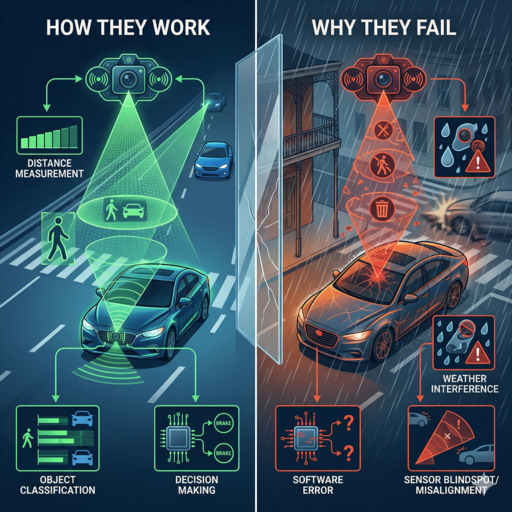
Collision avoidance systems function through a three-step process—Sense, Evaluate, and Act—using a network of sensors and software to detect hazards and trigger automatic braking or steering. While these “digital shields” are designed to prevent accidents on Louisiana roads, failures in sensor calibration or software logic can lead to catastrophic collisions where the manufacturer may be held liable for the technology’s failure to perform as marketed.
The Three-Step Process: Sense, Evaluate, Act
Collision avoidance systems are the “digital shield” of a modern vehicle. Whether it’s called a Pre-Collision System, EyeSight, or Active Brake Assist, the goal is the same: to detect a hazard before the driver does and intervene to prevent a crash.
While these systems are designed to improve safety on Louisiana highways, they are not infallible. At Bloom Legal, we investigate the complex network of sensors and software to determine why these “shields” fail when they are needed most.
The Hardware: Radar, LIDAR, and Cameras
Modern cars use a “sensor fusion” approach, combining different types of hardware to monitor the vehicle’s surroundings. In Louisiana car accident claims, we often find that environmental factors unique to the Gulf South have compromised this hardware:
- Radar: Usually mounted in the front grille, radar is excellent at detecting the speed and distance of objects, even in heavy Louisiana rain or fog.
- Cameras: Mounted behind the rearview mirror, these “see” the world like a human. They recognize lane lines but can be easily “blinded” by high-glare Louisiana sun or sudden downpours.
- LIDAR: Found in high-end or self-driving prototypes, LIDAR uses laser pulses to create a high-resolution 3D map of the vehicle’s path.
- Ultrasonic Sensors: These small circular sensors on your bumpers are designed for close-range detection, primarily used for parking and blind-spot alerts.
The Software: Evaluating the Threat
Every collision avoidance event follows a rapid, three-stage sequence that happens in milliseconds:
- Sense: The hardware scans the road for objects like other cars, pedestrians, or cyclists.
- Evaluate: The vehicle’s onboard computer (ECU) calculates the speed, distance, and trajectory of those objects. The system assesses “collision speed” to determine the urgency of the threat.
- Act: If a threat is detected, the system provides a Forward Collision Warning (FCW). If the driver fails to react, the system triggers Automatic Emergency Braking (AEB) to stop the car—often with zero human input.
Why Collision Avoidance Systems Fail
Despite marketing claims, these safety systems have documented limitations that lead to serious accidents in New Orleans and throughout Louisiana:
- Calibration Errors: If a windshield is replaced or a bumper is bumped without precise recalibration, the sensors “see” the world at the wrong angle, causing the car to miss hazards entirely.
- “Phantom Braking”: This occurs when the system misinterprets a shadow, a bridge, or a New Orleans manhole cover as a solid object, slamming on the brakes at highway speeds and causing rear-end crashes.
- Environmental Blindness: Systems are significantly degraded by mud on the sensors or driving directly into a low-hanging sun.
Proving Liability Under the 51% Bar
If your system failed to activate, the manufacturer will likely argue you were solely responsible. Under Louisiana’s Modified Comparative Fault rule (effective 2026), if they can prove you were 51% or more at fault for not intervening, you lose your right to any compensation.
We pull the Event Data Recorder (EDR) logs to show that the sensors “saw” the danger but the software failed to act. This evidence is crucial for keeping your fault percentage below the 51% threshold and shifting the liability back to the manufacturer.
Can I Sue if My Collision Avoidance System Failed?
Yes. If your vehicle was equipped with collision avoidance technology that failed to engage during a detectable hazard—or if the system malfunctioned and caused an accident—you may have a product liability claim against the automaker. Under the Louisiana Products Liability Act (LPLA), manufacturers are responsible for design defects or software glitches that make a vehicle “unreasonably dangerous.” At Bloom Legal, we help you hold these corporations accountable for the safety features they promised but failed to deliver.
Contact a Louisiana Vehicle Tech Accident Lawyer Today
If your car’s safety tech didn’t do its job, you need a law firm that understands the intersection of digital forensics and Louisiana law. Don’t let a “smart” car failure ruin your financial future.
Call Bloom Legal today at 504-599-9997.
Frequently Asked Questions
A Forward Collision Warning (FCW) is an alert intended to prompt the driver to take action. Automatic Emergency Braking (AEB) is the active stage where the car’s computer takes control of the brakes to stop the vehicle if the driver fails to respond.
Yes. Environmental debris like Louisiana mud can obstruct sensors. If the system fails to notify the driver that features are “unavailable” due to a blockage and then fails to prevent a crash, there may be grounds for a negligence claim.
Phantom braking occurs when the software incorrectly identifies a non-hazard as a threat. When a vehicle slams on its brakes unexpectedly at high speeds on the I-10, it often leaves the trailing driver with zero time to react.
The EDR records whether the system was active and what it “saw” before impact. If the EDR shows the radar detected an object but the computer failed to brake, it provides the proof needed to overcome the manufacturer’s “driver error” defense.