What to Do in the First 48 Hours After a DWI Arrest in New Orleans
An arrest for a DWI in New Orleans can be an overwhelming experience, leaving you with immediate concerns about your family, your job, your driver’s license, and your clean record. While it is completely normal to feel stressed, the steps you take immediately following your release from custody are critical. In Louisiana, a single traffic stop triggers two entirely separate legal timelines that begin running simultaneously. Knowing exactly what to do in the first 48 hours after a DWI arrest in New Orleans allows you to protect your rights, preserve your driving privileges, and establish a calm, clear strategy for your defense.
Secure Experienced Legal Representation
Your immediate priority after being released from custody should be consulting with a local attorney who regularly handles driving under the influence cases in Southeast Louisiana. Even a first offense justifies immediate legal representation, as the consequences affect both your daily mobility and your permanent criminal record. Navigating the local judicial system without counsel opens you up to missed deadlines and procedural mistakes that are incredibly difficult to correct later.
When you retain an attorney early, they take over all direct communication with law enforcement, state prosecutors, and the Office of Motor Vehicles (OMV). This protects you from making inadvertent statements to investigators that could later be used against you in court. Furthermore, an experienced defense attorney will immediately begin gathering evidence while it is fresh, such as requesting police incident reports, demanding the preservation of dashcam or body-worn camera footage, and pulling calibration logs for the chemical testing equipment used during your booking. An attorney will also help you navigate immediate logistical headaches following a drunk driving arrest, such as locating your vehicle and securing the documentation needed to retrieve your property from local impound lots quickly.
Request Your ALR Hearing Within 30 Days
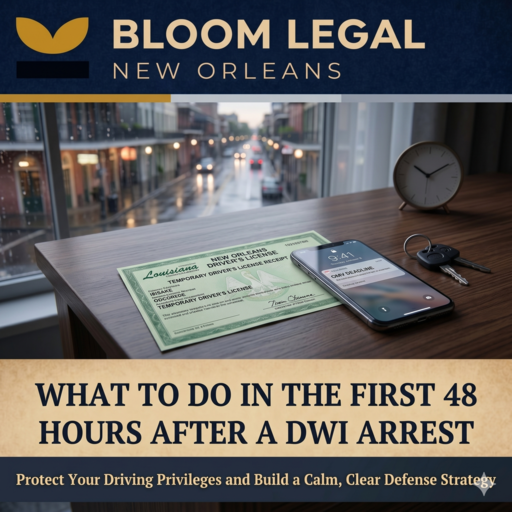
When you were released from jail, you were likely given a temporary driving receipt, which is typically printed on a standard green form. This document acts as your temporary driver’s license, but it also serves as an official notice from the state. Under Louisiana law, your driving privileges will be automatically suspended exactly 30 days from the date of your arrest unless a formal Administrative License Revocation (ALR) hearing is requested in writing.
The 30-Day OMV Timeline
- The Arrest Window: First 48 Hours.
This is your ideal tactical window to engage counsel, locate your impounded vehicle, and begin reviewing the initial details of your traffic stop.
- The Written Request: Before Day 30.
A formal, technical written petition must be submitted directly to the OMV along with the statutory fee to request an ALR hearing.
- The Administrative Pause: Pending the Hearing.
Filing this request on time effectively freezes the automatic suspension mechanism, allowing you to legally drive while your case is under review.
- The Legal Safeguard: Missed Deadlines.
If the deadline is missed or the suspension is upheld, you must pivot to securing a hardship license, an ignition interlock device (IID), and SR-22 insurance.
This 30-day timeline is strict and non-negotiable. Requesting an ALR hearing requires a specific written petition submitted to the OMV, which handles this administrative penalty entirely separate from your criminal case. Filing this request effectively pauses the automatic suspension, allowing you to legally operate your vehicle while your attorney reviews the state’s evidence and prepares to challenge the stop. If you miss this window, or if the suspension is ultimately upheld at the hearing, your attorney can walk you through the process of applying for a hardship license by installing an ignition interlock device (IID) and securing SR-22 insurance.
Document Everything While Your Memory Is Fresh
The hours immediately following your release are the most valuable time to write down every detail of your interaction with law enforcement, because the first 48 hours help establish the factual foundation for your entire defense. Find a quiet space and draft a comprehensive, chronological timeline of the events leading up to, during, and after your traffic stop.
Be sure to write down the following specifics:
- Details of the Traffic Stop: Note exactly where you were pulled over, the reason the officer gave for the stop, weather conditions, road quality, and traffic density.
- The Conversation: Record what specific questions the officer asked, how you answered, and whether you admitted to consuming alcohol or prescription medication.
- Field Sobriety and Chemical Tests: Detail the exact instructions you were given for physical balance tests. Note any physical factors, such as a pre-existing knee or back injury, inappropriate footwear, or uneven pavement, that may have interfered with your balance. Record whether you took a breathalyzer test or chose to refuse.
- Evidence and Witnesses: Keep all restaurant, bar, or parking garage receipts to establish an accurate timeline. Take clear photographs of any bruises or injuries from the arrest, and record the contact information of any potential witnesses.
Exercise Your Right to Remain Silent
It is completely natural to want to explain your side of the story to the police, prosecutors, or OMV personnel in the hope of resolving the situation quickly. However, the legal system is built on documentation, and any statements you make without an attorney present can be interpreted as admissions of fault and used to strengthen the prosecution’s case against you following a DUI arrest.
Do not discuss the facts of your arrest with anyone other than your lawyer. This rule applies to conversations with friends, posts on social media platforms, and interactions with law enforcement. Even seemingly innocent statements or photos posted online can be used by prosecutors to establish a timeline, argue your state of mind, or claim a pattern of impairment. If an investigator or a representative from the state contacts you, politely inform them that you have hired counsel and direct them to speak directly with your attorney’s office.
Understand the Two Tracks of a Louisiana DWI
A single DWI arrest in Louisiana initiates two completely separate legal proceedings that operate under different rules, take place in different venues, and move at entirely different speeds. Under Louisiana law, refusing a breath test does not stop the criminal case, as other circumstantial evidence can still be used to pursue a conviction.
| Legal Proceeding | The Criminal Court Track | The OMV Administrative Track |
| Governing Authority | Local Courts (e.g., Orleans Parish Criminal District Court) | Louisiana Office of Motor Vehicles (OMV) |
| Primary Focus | Criminal penalties, public safety, and a permanent record | Driving privileges and licensing requirements |
| Potential Outcomes | Court fines, supervised probation, community service, or jail time | License suspension, ignition interlock mandates, reinstatement fees |
| Timeline | Can take several months to over a year to resolve | Moves rapidly based on the strict statutory 30-day deadline |
Because these two systems operate completely independently, a favorable outcome in criminal court does not automatically fix your driving record. For example, a judge could dismiss your criminal charges due to an illegal traffic stop months from now, but you could still face a year-long license suspension if the 30-day OMV administrative deadline was neglected. An effective defense strategy must address both paths simultaneously from day one.
Frequently Asked Questions
What are the penalties for a first-offense DWI in Louisiana?
For a first-offense DWI with a blood alcohol content (BAC) below 0.15%, statutory penalties include a fine ranging from $300 to $1,000, court costs, up to 48 hours in jail, 32 hours of mandatory community service, and mandatory attendance at driver safety and substance abuse courses. Simply paying the ticket functions as a guilty plea, creating a permanent criminal conviction that can impact future employment and professional licensing.
Can an out-of-state driving record impact a local DWI case?
Yes. Louisiana utilizes a 10-year “lookback window,” or cleansing period. If you have a prior conviction for operating a vehicle while impaired or drunk driving in another state within the last 10 years, local prosecutors will attempt to use that record to elevate your current charge to a second-offense misdemeanor or a felony. However, out-of-state statutes must substantially match the legal structure of Louisiana’s laws to be used as an enhancement.
What happens to my license if I refused the breathalyzer or blood test?
Under Louisiana’s Implied Consent law, refusing to submit to a chemical test triggers an automatic administrative suspension of your driving privileges, which is typically longer than the suspension for taking the test and failing it. However, this suspension is not set in stone immediately and can still be contested by your attorney at your administrative hearing.
Request a Consultation
If you or a family member has recently been arrested for a DWI in the greater New Orleans area, acting quickly is the best way to protect your future. If you were released from the Orleans Parish Justice Center, you must also comply strictly with all bond and pretrial release conditions. At Bloom Legal, our boutique team of in-house attorneys focuses on guiding local residents through the complexities of both the criminal courts and the OMV administrative process. We work calmly, directly, and thoroughly to protect your rights, keep you on the road, and minimize the impact of an arrest on your daily life.
Contact our New Orleans office today to schedule a confidential consultation to review your paperwork and discuss your options.