The “Social Media Subpoena”: How Your New Orleans Festival Posts Can Become State Evidence
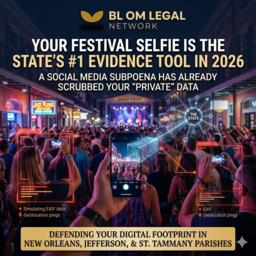
If you are a logistics manager in Metairie or a business owner enjoying a weekend in the French Quarter, you likely view your digital presence as a “Life-Side” highlight reel. You share the music, the food, and the atmosphere of Southeast Louisiana, trusting that your privacy settings are a sufficient shield. However, in the high-stakes legal climate of 2026, the Social Media Subpoena has been re-engineered into a proactive weapon of the state. The moment you upload a photo from a crowded street or tag your location in Jefferson Parish, you are providing the state’s “Digital Harvesting” systems with real-time telemetry. At Bloom Legal Network, we have observed a fundamental shift: a Social Media Subpoena is no longer just a request for messages—it is a comprehensive extraction of your “Behavioral Metadata” used by the state to verify your location, associations, and intent before you even realize you are under investigation.
The “Algorithmic Dragnet”: How Southeast Louisiana Uses Digital Audits
In previous years, a criminal investigation in St. Charles Parish relied on physical evidence and eyewitness testimony. Today, the “Data-Sync” era means the state of Louisiana utilizes “Sentiment AI” to scan public and “private” festival posts for “Risk Friction Points.” Within seconds of a post going live, local authorities in New Orleans and St. Tammany Parish can cross-reference your background visuals against smart-city sensor data to create a “Geographical Consistency” report.
When you are navigating the risks of the Social Media Subpoena, you must realize that prosecutors are no longer looking for a “smoking gun” photo. They are looking for “Behavioral Evidence”—the small, digital breadcrumbs that suggest you were in a specific “Geofenced” zone during a reported incident. If your metadata shows a “latency” between your actual location and your post time, the state’s automated monitoring systems may flag this as “Criminal Concealment.”
Bloom Legal Network Proactive Shield: Our dedicated legal team understands that the digital rules of engagement have fundamentally changed. We act as your primary advocate, intercepting these “Red Flags” and challenging the validity of automated data harvests. Call 504-599-9997 to secure your defense before the state’s algorithm locks in its judgment of your character.
Step-by-Step: Managing Your “Digital Perimeter”
The state of Louisiana now views your social media history as a liquid asset that can be frozen or seized. To protect your legacy and your career, follow these high-tech protocols when attending high-traffic events in Southeast Louisiana:
1. Preserve the “Metadata Integrity”
Do not attempt to mass-delete posts or “scrub” your history if you suspect you are being monitored. In the current 2026 regulatory climate, any sudden gap in your digital footprint is categorized by prosecutors as “Spoliation of Evidence.” Whether you are at a crawfish boil in Kenner or a gala in New Orleans, the state’s “72-Hour Digital Audit” will flag a deleted profile as an admission of guilt. Any Social Media Subpoena issued later will highlight this gap as a “Risk Friction Point.”
2. Identify “Association Risk Points”
Who is in the background of your photo? Who tagged you in their “Story”? Prosecutors in Southeast Louisiana now use “Relational Mapping” to link you to individuals who may already be under a “Silent Timer” for a regulatory audit. Bloom Legal Network stays by your side, managing the process to ensure that a “guilty by association” algorithm doesn’t dismantle your professional reputation.
3. Verify “Timestamp Synchronicity”
Authorities in Jefferson and Orleans Parishes use AI to verify if the weather, lighting, and shadows in your festival posts match the official meteorological data of that day. If your post “pings” suggest you were in Metairie but your photo shows a background identifiable as the Mandeville lakefront, you are at risk for a “Material Misrepresentation” charge.
Why “Standard” Legal Advice is a 2026 Liability
Many residents in Southeast Louisiana mistakenly believe that simply setting an account to “Private” protects them from a Social Media Subpoena. However, the intersection of Louisiana’s civil law and the data-sharing habits of modern platforms requires a specialized, high-tech strategy. Third-party apps and “Shadow Profiles” often store data that you believe was deleted years ago.
Knowing how to respond to a Social Media Subpoena means knowing who to call. Whether we handle your case directly or bring in a specialized partner from our trusted network, you’ll always have a dedicated legal team working for you—from start to finish. If your case involves complex digital forensics or data privacy breaches near the Port of New Orleans, we have the network to bring in those insights while staying by your side the entire way.
The Hidden Danger of “Administrative Admissions”
In St. Tammany Parish or Orleans Parish, it is tempting to respond to a “minor” digital inquiry or a “friendly” DM from a local investigator to make a situation go away. In 2026, this is a catastrophic strategic error. Any informal admission of your location or activity is recorded by state algorithms as a “Verified Risk Profile.”
This admission then feeds into the “Risk Profile” that state investigators use to justify more aggressive future subpoenas. At Bloom Legal Network, our clients trust us because we put their needs first. We ensure that a casual post during a New Orleans festival doesn’t lead to a massive criminal indictment or a “Digital Audit” that freezes your business assets.
Protecting Your “Life-Side” in a Ruthless Era
The 2026 legal landscape is built to be reactive; you must be proactive. By securing a dedicated legal team at the first sign of a “Red Flag,” you compartmentalize the battle. You focus on your business and your family in Southeast Louisiana while we handle the heavy lifting of data privacy, administrative policy, and defending against a Social Media Subpoena.
At Bloom Legal Network, we’re a full-service law firm backed by a trusted network of attorneys. Whether we handle your case directly or bring in a specialized partner, you’ll always have a dedicated legal team working for you—from start to finish. Our clients trust us because we put their needs first. If your case requires specialized knowledge, we have a network of attorneys we trust—but we stay by your side the entire way, managing the process and protecting your interests.
📞 Call 504-599-9997 📧 Email info@bloomlegal.com
Frequently Asked Questions
How does a “Social Media Subpoena” differ from a standard warrant in 2026?
In the current legal climate, a warrant is often specific to a physical location, but a Social Media Subpoena is a wide-ranging “Digital Audit” of your entire history. In Southeast Louisiana, authorities use these subpoenas to harvest “Behavioral Metadata”—not just what you said, but where you were, who you were with, and how long you stayed. This data is then fed into a “Sentiment AI” that determines if your lifestyle matches a “Risk Profile.” This is why having a legal team that understands “Digital Perimeter” defense is vital to preventing the state from building a case out of context.
Can the state use “Deleted” posts from years ago in a New Orleans criminal case?
Yes. Through the “Data-Sync” era infrastructure, the state of Louisiana has access to server-side archives that often persist long after you hit “delete” on your phone. If a Social Media Subpoena is issued in Jefferson Parish or St. Tammany, the state can retrieve “Shadow Data” to prove “Criminal Intent” or “Geographical Inconsistency.” Bloom Legal Network works with technical partners to audit what the state actually has, forcing a human review of the facts to override the computer’s biased “Risk Profile.”
What should I do if I receive a notification that my data has been requested?
Do not contact the platform and do not reach out to the investigating officer in Orleans or St. Charles Parish. In the 2026 “Digital Audit” era, the system logs your reaction to the notification as part of your “Behavioral Evidence.” Any sudden change in your posting habits or privacy settings after a notification is categorized as an admission of non-compliance. Our “Network” philosophy allows us to bring in specialized insights to help you navigate a “Voluntary Disclosure” strategy or move to quash the subpoena entirely. We stay by your side the entire way, managing the process and protecting your interests from the first phone call to the final resolution.