Recorded Statement: The Friendly Call That Can Kill Your Personal Injury Claim
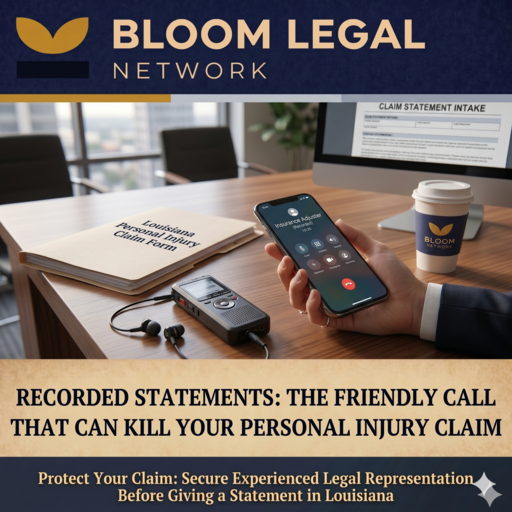
Insurance adjusters are trained professionals whose primary objective is to minimize financial payout for their employers. Shortly after an accident, an adjuster may contact an injured party under the guise of customer service or a routine wellness check, requesting a “recorded statement” to “speed up the process.” While the tone of these calls is often casual and accommodating, this interaction represents a critical legal vulnerability for an unrepresented claimant.
Understanding the strategic purpose behind these requests and knowing how to handle them is essential to preserving the integrity of a personal injury claim in Louisiana.
The Strategy Behind the “Friendly” Insurance Adjuster Phone Call
The immediate period following an injury is a highly sensitive tactical window. An insurance representative may reach out to accident victims before they know the full extent of the injuries sustained, while they are still experiencing acute stress, managing medical treatment, or taking prescribed medications that alter cognitive clarity.
The primary goal of obtaining an early recorded statement is rarely to gather neutral facts; rather, it reflects how insurance companies operate, with the opposing insurance company trying to collect documentation it can later use to reduce financial responsibility, not to help the claimant. Adjusters frequently utilize deceptive tactics, specific phrasing, and conversational pacing to achieve several key objectives:
- Establishing Pre-Existing Conditions or Alternative Causes: Casual questions regarding daily routines or past medical history are often designed to discover alternative explanations for an injury, shifting liability away from the accident.
- Locked-In Early Assessments: Soft-tissue injuries or internal trauma often take days or weeks to manifest fully. An early statement made before treatment or before someone understands the full extent of harm can be used to argue the injuries are minor, especially if the caller said “I feel fine” or “nothing else hurts.”
- Inconsistencies in Recalled Details: Memory of a traumatic event naturally fluctuates. Even a small change in how the accident happened can be framed as a credibility problem because the statement may become part of the official record and claim file.
- Fault-Shaping Questions: Adjusters may use leading questions and ask the same question in different ways to draw out admissions that support partial blame under comparative negligence.
Casual, friendly wording can be twisted against you, and even one misplaced phrase in a recorded interview may be used to deny the claim entirely.
The Legal Reality: In Louisiana, you are under no statutory obligation to provide a recorded statement to the at-fault party’s insurance company without an attorney present.
Navigating the Immediate Post-Accident Window
Protecting a claim requires a disciplined approach to communication in the days following an incident. The structural timeline below outlines the standard sequence of events and how to maintain procedural safety at each stage:
Seek Immediate Medical Evaluation:**First 24–48 Hours.
Prioritize a comprehensive physical exam. Seek treatment and obtain proper medical care so delayed issues like physical pain or soft tissue damage are documented promptly by a medical professional to establish a clear causal link to the accident.
Document the Scene and Context:**While Memory is Fresh.
Write down a private, chronological timeline of the event. Preserve photos of property damage, environmental conditions, police reports, witness statements, and medical records, along with contact information for any independent witnesses.
Decline Unsolicited Recorded Requests:**Upon Initial Contact.
If contacted by the at fault driver’s insurer, the other driver’s insurance company, or the other party’s insurance company, politely decline to give a recorded statement or sign any authorizations, because in Illinois you are not legally required or legally obligated to do so. Declining a request from the driver’s insurance company or any party’s insurance company will not prevent the claim from moving forward.
Engage Experienced Personal Injury Counsel:**Before Sharing Details.
Retain an experienced personal injury attorney or personal injury lawyer to take over direct communication with all insurance entities and provide legal guidance before any formal interview conducted, which can protect your rights and keep your words from being misinterpreted or used against you. Your own insurance provider or insurance provider may still request cooperation under insurance policies, including a cooperation clause, so counsel should prepare you before any formal interview.
Evaluating the Risks of Direct Communication
The civil legal system relies heavily on documentation. Every admission, omission, or imprecise phrase recorded during an informal call can alter the trajectory of settlement negotiations, and a recorded statement can become a permanent record used throughout a personal injury case.
| Conversational Trap | Insurance Objective | Legal Impact on Claim |
|---|---|---|
| “How are you doing today?” | Elicit a polite, reflexive “I’m doing well” or “Good.” | Used to argue that injuries are not as severe as documented, or that saying you feel fine means the injuries were not serious or were unrelated to the accident. |
| “Just give me a brief overview…” | Encourage narrative speculation about speeds, distances, or timing in a formal interview where adjusters may use leading questions to shape the answer. | Minor factual errors are later framed as intentional contradictions. |
| “We want to resolve this quickly.” | Offer a low, immediate settlement before the full scope of medical costs is known. | Accepting an early check requires signing a release, waiving all future claims. |
Conflicting statements in the recording can also be used as leverage to lower payouts, undermine credibility, and give insurance companies evidence they can weaponize during settlement negotiations as part of that permanent record.
Frequently Asked Questions
What should I say if an adjuster calls me before I have hired a lawyer?
You should remain polite but concise. Inform the adjuster that you are currently focusing on your medical recovery and seeking legal representation, and that you want legal help from a personal injury attorney before responding further. State clearly: “I am not prepared to give a statement or sign any forms at this time. Please provide your contact information, and my attorney will reach out to you directly.” Do not engage in small talk or answer questions about your physical condition.
Does this rule apply to my own insurance company?
Your relationship with your own insurer is governed by your policy contract, and you may need to assist your own insurance provider or insurance provider with a formal statement under the policy. However, you should do so with legal counsel and still have the right to consult with an attorney before providing formal statements or signing documents, especially if there is a possibility of an uninsured/underinsured motorist claim.
Can a recorded statement affect a claim if the accident was clearly the other person’s fault?
Yes. Even in clear-cut liability cases (such as a rear-end collision), an adjuster can use a recorded statement to attack the damages portion of the claim. Adjusters may also try to use even minor admissions to shift comparative fault and reduce fair compensation or maximum compensation. If you minimize your injuries or misstate your medical history during the call, the insurer will use that recording later in settlement negotiations and financial recovery discussions to challenge damages and reduce the financial compensation offered for medical bills, lost wages, and pain and suffering.
Request a Free Consultation
Managing the aftermath of a personal injury while protecting your legal rights requires a strategic, deliberate approach, especially for car accident and auto accident claims. At Bloom Legal Network, our legal team helps accident victims protect a claim from the opposing insurance company by taking over all direct negotiations, evidence gathering, and procedural hurdles so you can focus entirely on your recovery. We understand the tactics used by insurance companies to undervalue claims, and we work thoroughly to ensure your long-term financial and physical well-being is protected. Legal representation is available if you need guidance after a recorded statement request.
Contact our office today to schedule a confidential free consultation to review your case and safeguard your claim.