
One Wrong Sentence in a Police Report Can End a Career: Why Your Story Is Already Being Written in Southeast Louisiana
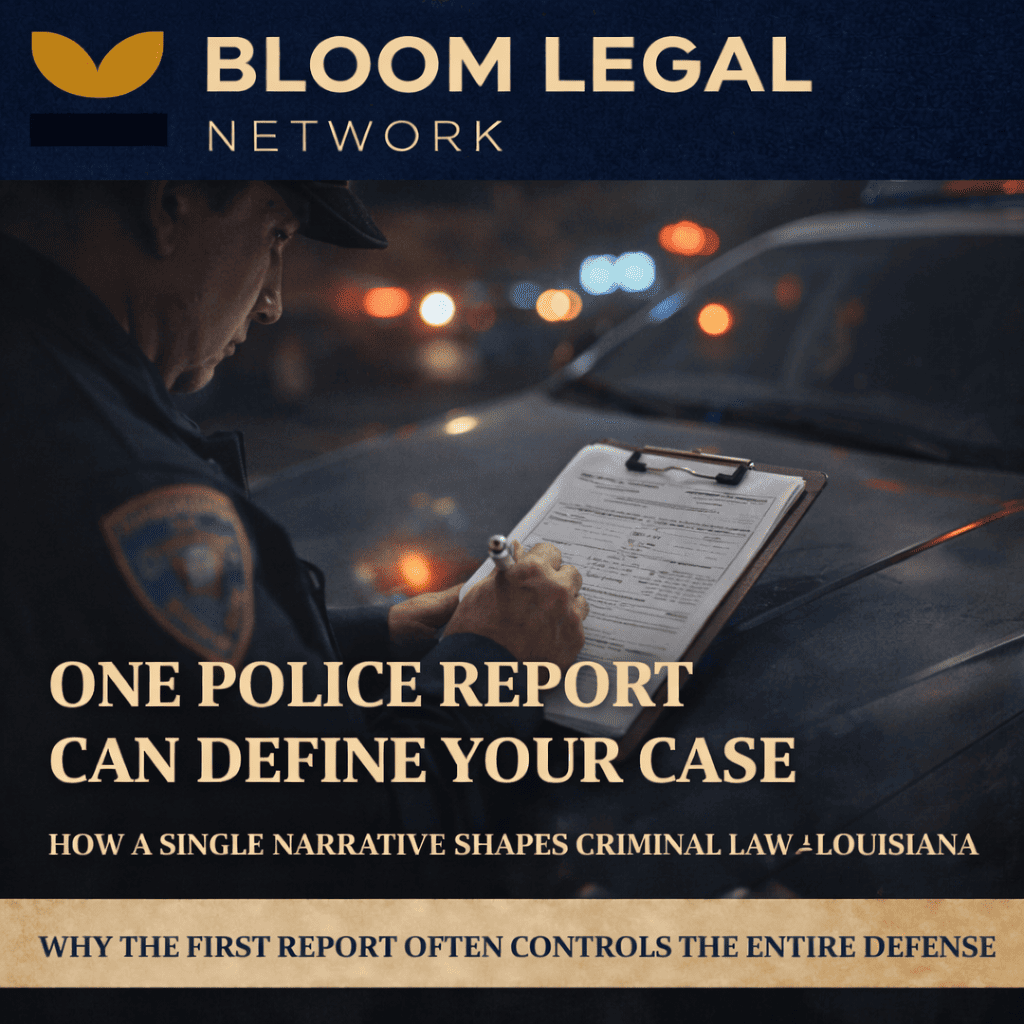
“I’ll just explain it to the officer.”
It is the most common—and most dangerous—assumption we encounter at Bloom Legal Network. In the world of criminal law in Louisiana, many people believe that a police report is a neutral record of facts, a “he-said, she-said” document that gives equal weight to both sides. The reality is far more clinical and far more consequential. By the time a deputy in Jefferson Parish or an officer in New Orleans finishes their narrative, the trajectory of your case has often been set. Before you ever stand before a judge or speak to a prosecutor, that single document acts as the foundation for everything that follows. It isn’t just a summary; it is the lens through which the state views your character, your intent, and your guilt.
Common errors in police reports can have severe consequences for the accused, affecting the outcome of criminal investigations and even the course of a trial.
If you or a loved one are mentioned in an active investigation, the time to protect your record is now. Contact Bloom Legal Network at 504-599-9997 to ensure your interests are managed by a dedicated legal team from start to finish.
The Narrative Gap: Why the First Version Wins
In criminal law in Louisiana, the police report is the first “official” story. Prosecutors, who handle hundreds of files a week, often rely almost exclusively on this summary to decide whether to charge someone with a crime or drop the matter.
When an incident occurs in Metairie or Kenner, the responding officer is looking for “probable cause.” They aren’t there to conduct an exhaustive deep-dive into the nuances of a business dispute or a heated domestic argument. They are looking for elements of a crime.
Once an officer decides there is enough evidence to make an arrest or file a report, their writing naturally shifts to support that conclusion. Officers often use active voice to make their narrative more direct and persuasive. They highlight the “incriminating” facts and often minimize or omit the “exculpatory” ones—the facts that point toward your innocence. The circumstances of the incident are often summarized in a way that supports the officer’s conclusion. This creates a narrative gap where your perspective is effectively erased before the legal process even begins, and what officers choose to note in their reports can shape the entire narrative.
The Geography of a Report: From New Orleans to St. Tammany
While the statutes of criminal law in Louisiana remain the same, the way police reports are generated and utilized can vary across the region.
- In New Orleans: Given the high volume of cases, a police report is often the only thing a prosecutor sees for weeks. If that report is written poorly or contains inaccuracies, those errors become “fact” in the eyes of the District Attorney’s office. Factual errors or an inaccurate police report can quickly become accepted as truth by prosecutors, making it critical to address any mistakes as soon as possible.
- In St. Tammany and St. Charles Parishes: Officers may provide more detailed narratives, but detail does not always equal accuracy. A more “thorough” report can often mean more opportunities for a detective to include subjective observations about your “demeanor” or “uncooperative attitude,” which can be used to argue consciousness of guilt later. However, more detailed reports can sometimes include incorrect information, resulting in an inaccurate report that misrepresents what actually happened.
At Bloom Legal Network, we understand how these local nuances impact your case. Our network of attorneys stays by your side, managing the process and protecting your interests regardless of which parish the incident occurred in.
Observations vs. Interpretations: The “Demeanor” Trap
One of the most damaging aspects of a police report is the section involving officer observations. In criminal law in Louisiana, an officer’s interpretation of your behavior is often given the same weight as physical evidence.
A report might state: “Subject appeared nervous and avoided eye contact.”
In reality, you were likely in shock, overwhelmed, or following the common-sense instinct to be careful with your words. However, on paper, “nervous” is code for “guilty.” Similarly, if you assert your right to remain silent, a report might characterize you as “combative” or “evasive.” These subjective labels follow you. While an officer may believe they are giving their honest opinion, there is always a risk that their interpretation is misread or misrepresented. Most officers strive for accuracy, but even a small lie or mischaracterization in a report can have lasting consequences for the person involved. They influence the bond amount set by a magistrate and the willingness of a prosecutor to negotiate a plea.
This is why having a legal team to counter these narratives early is vital. If a report is already working against you, Bloom Legal Network can help step in to provide the necessary context and correction.
How “Small” Errors Lead to Large Problems
We frequently see cases in Southeast Louisiana where a simple clerical error in a police report creates a domino effect. An incorrect address, a misunderstood timeline of events, or a misattributed statement can lead to a warrant being issued for the wrong charge. Beyond clerical mistakes, false reporting or filing a false police report can result in even more severe legal consequences for law enforcement, including potential criminal charges.
In the realm of criminal law in Louisiana, once a report is filed, it is notoriously difficult to change. It is an official government record. If you try to call the precinct to “fix” the report yourself, you are likely creating more recorded statements that can be used against you. Proving that a report contains errors or was written incorrectly can be extremely challenging, especially when intentional false reporting is suspected.
Instead of attempting to handle a detective or a reporting officer on your own, you need a structured legal intervention. Whether our firm handles your case directly or we bring in a specialized partner from our trusted network, we ensure that every piece of evidence—including the way officers write their police reports—is scrutinized for inaccuracies, because even small mistakes can have major consequences.
The Silence of the Accused
The most important thing to remember about a police report is what it doesn’t contain. If you followed the correct legal advice and exercised your right to remain silent, the report will be one-sided. However, omissions in a police report can lead to other consequences beyond the immediate case, potentially affecting the broader justice process and even the careers of law enforcement officers.
This is actually a strategic advantage, provided you have a legal team ready to fill that silence at the right time. In criminal law in Louisiana, your defense isn’t built by arguing with the officer on the street; it’s built by your attorneys presenting a counter-narrative to the prosecutor in a controlled, strategic environment. Remember, virtually everything in your legal process can be influenced by what is or isn’t included in the initial report.
Report Writing Skills for Officers
Effective police report writing is a cornerstone of the criminal justice system. For police officers, mastering report writing skills is not just about paperwork—it’s about ensuring that every police report stands up to scrutiny in court and supports the pursuit of justice. A well-written police report is clear, concise, and objective, capturing the key details of an incident without unnecessary commentary or bias.
Developing strong report writing skills means knowing what to include and, just as importantly, what to leave out. Police officers must focus on factual accuracy, using precise language and terminology that will be understood by prosecutors, defense attorneys, and judges. Training in report writing emphasizes brevity, the correct use of quotations, and the importance of documenting only what was observed or reliably reported—not personal opinions or assumptions.
On-the-job training (OJT) and ongoing professional development help officers refine their investigative writing, ensuring that each report meets the high standards required by law. Attention to detail is critical; even a small mistake or omission can have significant consequences for the parties involved and the outcome of a case. By continually improving their report writing skills, police officers help support the integrity of the justice system and ensure that their documentation can withstand the demands of further investigation and legal review.
Understanding Your Rights After Filing a Police Report
Filing a police report is a significant step in any legal process, and it’s essential to understand your rights and responsibilities once that report is on file. If you believe a police report contains inaccurate or false information, you have the right to challenge it and provide evidence to support your claim. Start by obtaining a copy of the police report from the police department and reviewing it carefully for any mistakes, missing details, or statements that do not reflect what actually happened.
If you find errors, you can request that a law enforcement officer file a supplemental report or correction. Providing witness statements or additional documentation can help clarify discrepancies and support your version of events. Remember, a police report can play a vital role as evidence in court or during a criminal investigation, so it is crucial that the information is accurate and complete.
If the police report is being used in a legal proceeding, further investigation may be necessary to uncover the truth and correct any inaccuracies. Understanding your rights in this process can help you avoid unintended consequences and protect your interests. If you are unsure about how to proceed or feel overwhelmed by the process, consulting with a legal professional or experienced law enforcement officer can provide the guidance you need to ensure that your claim is properly supported and that justice is served.
Managing the Process from Start to Finish
At Bloom Legal Network, we’re a full-service law firm backed by a trusted network of experienced attorneys. We know that a criminal case doesn’t start in the courtroom—it starts the moment the flashing lights appear in your rearview mirror or a knock comes to your door in St. Charles Parish. Criminal investigations often begin with the initial police report and the details it contains.
Our clients trust us because we put their needs first. If your case requires specialized knowledge, we have a network of attorneys we trust—but we stay by your side the entire way, managing the process and protecting your interests. We don’t just read the police report; we deconstruct it.
If you are concerned about what is being written about you in an official record, do not wait for the charges to be filed. The trajectory of your life may depend on how that report is handled today.
📞 Call 504-599-9997 📧 Email info@bloomlegal.com
Frequently Asked Questions
1. Can I get a police report changed if I see a mistake in it? Directly asking an officer to change a report is rarely successful and can be legally risky, as it may be viewed as an attempt to interfere with an investigation. In the context of criminal law in Louisiana, the proper way to address errors is through your legal counsel. Your attorney can gather independent evidence—such as surveillance footage, witness statements, or digital records—to demonstrate the inaccuracies in the report to the prosecutor. At Bloom Legal Network, we focus on building a comprehensive defense file that corrects the record through the proper legal channels rather than through informal requests to the police department.
2. If the police report says I confessed, but I didn’t, what happens next? This is a serious but unfortunately common situation in Southeast Louisiana cases. Officers may “summarize” a conversation in a way that sounds like an admission of guilt (e.g., “The suspect admitted to being at the scene” becomes “The suspect admitted to the crime” in the written report). To fight this, your legal team will look for body camera footage, audio recordings, or inconsistencies in the officer’s testimony. Because criminal law in Louisiana places high value on these reports, challenging an officer’s written narrative requires a meticulous and aggressive legal strategy to ensure your true statements are what the court actually considers.
3. Does a “supplemental report” mean I am in more trouble? Not necessarily, but it does mean the investigation is ongoing. A supplemental report is filed when new information comes to light—such as new evidence, a follow-up interview, or lab results. In parishes like Jefferson and St. Tammany, detectives often use supplemental reports to “bridge the gap” between an initial arrest and the formal filing of charges. If you learn that a supplemental report is being drafted, it is a clear signal that you need a legal team to manage the flow of information. Bloom Legal Network remains by your side through every update to your case, ensuring that new information is analyzed and countered before it can do further damage to your defense.
4. What should I do if a police report contains errors after a car accident?
If you notice mistakes in a police report following a car accident, it’s important to act quickly. Inaccurate accident reports—especially those involving your vehicle details, accident scene evidence like skid marks, or even witness statements—can have serious consequences for insurance claims and legal proceedings. This is especially critical if the accident resulted in a death, as errors can impact criminal investigations and may lead to trial. If false information is intentionally provided, it could result in criminal charges, jail, or even prison time. To correct the report, your attorney can help you gather evidence, interview witnesses, and present documentation to the authorities. Accurate accident scene details, such as photographs of skid marks or damage to your car, can be crucial. Always consult with legal counsel to ensure the correction process is handled properly and your rights are protected.