The Visa Trap: Why an Approved Visa Still Isn’t Safe After a Louisiana Arrest
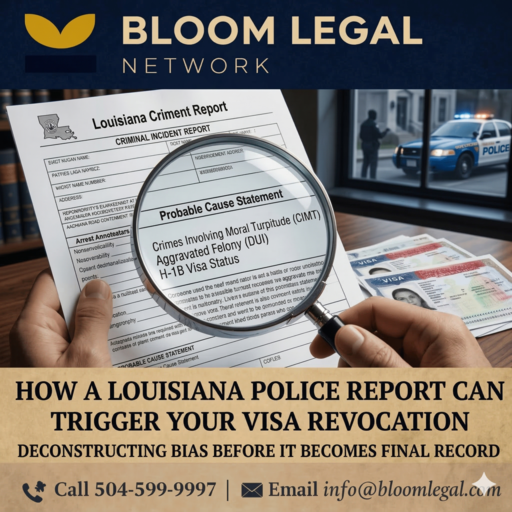
For many professionals and families living in Southeast Louisiana, receiving an approved visa is the culmination of years of hard work and thousands of dollars in legal fees. You imagine your status is a solid foundation for your life in America. However, there is a terrifying reality that many non-citizens only discover when it is too late: when an approved visa still isn’t safe, it is usually because of the aggressive intersection between local police reports and federal immigration enforcement. From the moment an officer in Metairie or New Orleans clicks “save” on a digital report, a version of “the truth” is solidified that can trigger a visa revocation or an ICE detainer long before you ever hire an attorney or stand before a judge. In the Louisiana justice system, the initial police report can have a profound impact on your life, shaping immigration outcomes and influencing your future well before you have a chance to defend yourself against the state’s charges.
The Invisible Script: Why an Approved Visa and Immigration Status Still Aren’t Safe in Jefferson Parish
In the busy courtrooms of Jefferson Parish and St. Charles Parish, efficiency is the priority. Judges and prosecutors often have hundreds of files to review daily. They don’t have the luxury of deep-diving into your history as a law-abiding visa holder; instead, they “anchor” their entire perception of you to the initial police report.
The police report frequently frames the alleged crime in a way that shapes how judges and prosecutors view the case from the outset. If a St. Tammany Parish deputy describes you as “evasive” rather than “confused by a language barrier,” that single adjective can lead to a higher bond and a direct notification to federal authorities.
Recent cases have shown how police officials, including police chiefs and ex police chiefs from small central Louisiana municipalities, were arrested in Baton Rouge as part of a federal investigation into visa fraud schemes. U.S. Attorney Alexander C. Van Hook discussed these arrests at a news conference, as local news outlets reported. These cases involved other arrests and highlighted the significant role law enforcement can play in the visa process and related fraud.
At Bloom Legal Network, we recognize that these reports are often written under stress and with a natural bias toward justifying an arrest. Our job is to intervene before that biased script becomes a permanent record that threatens your residency.
If you suspect the report in your case contains inaccuracies, you cannot afford to wait. Contact Bloom Legal Network to ensure your narrative is being managed by a team that understands how to deconstruct “police-speak.”
The 72-Hour Window: The Critical Clock for Non-Citizens
When you are arrested in Southeast Louisiana, the clock starts ticking immediately. Under Louisiana Criminal Procedure Article 230.1, you must be brought before a judge within 72 hours. This window is not just about your state-level bond; it is the primary window where ICE (Immigration and Customs Enforcement) monitors local jail rosters. An arrest can jeopardize your legal status, especially if you have a prior criminal record, making it even more critical to act quickly.
If the “Probable Cause Statement” in your police report uses specific keywords, it can trigger an immigration hold. This is why immediate strategic action is mandatory. At Bloom Legal Network, we are a full-service law firm backed by a trusted network of experienced attorneys. We don’t take the officer’s word at face value. We work to ensure that the “silent” narrative in your file is one of constitutional protection, not a signal of immigration risk. Immigration authorities may transfer individuals to a detention facility if they determine there is a risk of removal.
Whether you are facing a DUI in Gretna or a more serious felony in St. Tammany, the first impression a prosecutor gets will set the tone for:
- Charging Decisions: Will they pursue a charge that constitutes a “Crime Involving Moral Turpitude” (CIMT)?
- Plea Bargaining Power: Will a plea deal accidentally make you deportable under federal law?
- Judicial Disposition: Does the judge see you as a flight risk because of your visa status?
Deconstructing “Police-Speak”: Turning Subjectivity into Strategy
Police officers are trained to use specific language that sounds objective but is often highly subjective. In Louisiana criminal law, certain phrases act as “red flags” for both judges and immigration officials. Understanding when an approved visa still isn’t safe requires a legal team that can read between these lines.
Recent federal investigations have uncovered an alleged scheme involving government officials and police officials who provided falsified reports, including false police reports about armed robberies that never actually occurred, to help immigrants apply for special visas such as the U visa. These reports often showed an unusual concentration of crimes and included suspicious law enforcement signatures that were not properly cross referenced or verified with authorized signatures. The inspector general and the Homeland Security Department conducted audits and published data revealing deficiencies in the U visa program, including fraud case outcomes and the need for effectively managing the backlog and addressing deficiencies. The U visa program, as published by USCIS, is designed to help crime victims who have suffered mental or physical abuse from certain crimes, but crime victims waiting for relief often face long delays. Immigration attorneys, immigration services, and organizations like the American Immigration Lawyers Association play a crucial role in helping green card holders, green cards applicants, and other immigrants navigate immigration law, citizenship, and re-entering the country after travel. Some cases involved individuals from British Columbia or other foreign countries, and seeking asylum or returning to one’s home country can be complicated by a criminal record or being convicted. Published data and audit findings by the inspector general found that the program published by the Homeland Security Department had not fully addressed deficiencies in fraud detection and backlog management.
| Officer’s Phrase | Potential Immigration Risk | Strategic Defense Counter |
|---|---|---|
| “Furtive movement” | Used to justify searches that find “removable” evidence. | Challenge the legality of the stop and the search. |
| “Strong odor of intoxicants” | Can trigger “Prudential Revocation” of a visa by the State Dept. | Prove medical emergency or lack of clear instruction via body cam. |
| “Inconsistent statements” | Makes a nervous visa-holder look like they are committing fraud. | Reframe as exercising Constitutional 5th Amendment rights. |
At Bloom Legal Network, we believe our clients trust us because we put their needs first. If your case requires specialized knowledge of how these phrases impact your specific visa category (H-1B, L-1, O-1, etc.), we have a network of attorneys we trust—but we stay by your side the entire way, managing the process and protecting your interests.
The Danger of Omission: What the Report Doesn’t Say About False Police Reports
One of the most effective ways a police report shapes a case is through silence. Officers in Kenner or New Orleans rarely include details that favor the defendant. If you were cooperative, if there was a cultural misunderstanding, or if the “victim” was actually the aggressor, these facts are often left on the cutting room floor.
These omissions create a one-sided story that can make an approved visa feel like it isn’t safe anymore. We ensure that the “missing” pieces of your story are brought to the prosecutor’s attention early. Further investigation is often necessary to uncover omitted facts—such as surveillance footage or witness statements—to ensure the full story is presented.
Before you ever speak a word in a Louisiana courtroom, your credibility is already being weighed. A report that characterizes you as disrespectful can lead to “vindicative prosecution,” where the state is less likely to offer leniency that protects your immigration status.
Why You Need a Unified Defense Strategy with an Immigration Attorney
A criminal conviction in Louisiana can have lasting consequences, from prison time to a permanent mark on your criminal record that prevents you from ever becoming a U.S. citizen. Being convicted of certain crimes can result in a permanent criminal record, jeopardizing your green card and your path to citizenship. Green card holders and those seeking green cards face unique risks under immigration law, as a conviction can lead to deportation or loss of legal status. Consulting an immigration attorney who understands immigration law and the specific vulnerabilities of green card holders is crucial. Experts like David Leopold, former president of the American Immigration Lawyers Association, emphasize the need for specialized legal guidance in these cases. With the right legal guidance, you can reduce anxiety and develop a defense strategy tailored to your case—whether that means negotiating a plea that avoids immigration “conviction” definitions or taking your case to trial.
If you or a loved one is facing criminal charges, don’t wait. The sooner you seek a consultation with an experienced legal team, the better your chances of protecting your rights and your future.
📞 Call 504-599-9997
📧 Email info@bloomlegal.com
Frequently Asked Questions
Does a “Dismissal” or “Diversion” program in Louisiana mean my visa is safe?
Not necessarily. This is a common point of confusion. Under the Immigration and Nationality Act (INA), the definition of a “conviction” is much broader than the Louisiana definition. If you enter a plea of guilty or “no contest” (nolo contendere) and the judge imposes any form of restraint on your liberty—such as probation, a fine, or community service—it is considered a conviction for immigration purposes. This is true even if the charges are later dismissed under Article 893 or 894, or through a Pre-Trial Diversion program. Because federal law does not recognize state-level expungements for immigration benefits, you must be extremely careful about the type of deal you accept in Jefferson Parish or Orleans Parish. We work to ensure your plea does not inadvertently trigger deportation.
What is a “Prudential Visa Revocation” and how does a New Orleans arrest trigger it?
A Prudential Revocation happens when the Department of State revokes a physical visa foil in your passport because of an arrest, even before a conviction occurs. This most commonly happens with DUI or alcohol-related arrests in Southeast Louisiana. Once the arrest is entered into the federal database, the National Visa Center may send an email notifying you that your visa is no longer valid for travel. While this doesn’t necessarily mean you are “out of status” while remaining in the U.S., it means the moment you leave the country, you cannot return without a new visa interview and medical clearance. This is a primary example of when an approved visa still isn’t safe despite your best efforts to follow the law.
Can I be deported for a misdemeanor in Louisiana if I have a green card or a valid work visa?
Yes. Certain misdemeanors are classified as “Crimes Involving Moral Turpitude” (CIMT) or can be categorized as “Aggravated Felonies” under federal law, even if they are handled in a lower court in Louisiana. Common examples include shoplifting, certain domestic violence charges, or repeated DUI offenses. If a police report in St. Tammany or Jefferson Parish is written in a way that suggests “intent to defraud” or “intentional violence,” it can trigger removal proceedings. Holders of student visas and work visas also face risks to their legal status and may be denied the ability to re-enter the U.S. after travel abroad if they are arrested or convicted. Understanding immigration law is critical for anyone with a visa or green card facing criminal charges, as your legal status and re-entry rights can be directly impacted. Having a legal team that can deconstruct “police-speak” and challenge the narrative in the report is the only way to protect your long-term residency. Regardless of the complexity, we stay by your side the entire way, protecting your interests.