
Louisiana Business Partners: Why “Handshake Deals” Are the #1 Trigger for Criminal Law in Louisiana Cases (And How to Stop It)
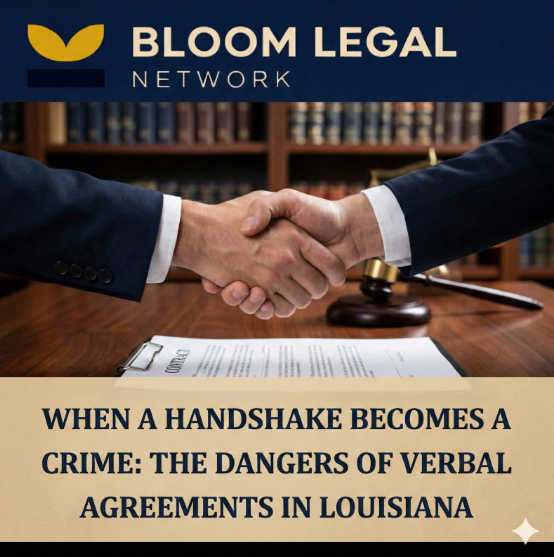
“We trusted each other.”
It is the sentence we hear most often before a client realizes they are a suspect, not just a business partner.
In criminal law in Louisiana, some of the most serious legal problems begin with something that feels harmless: a handshake. No paperwork. No lawyers. Just trust, history, and the assumption that “we’ll handle the details later.”
In New Orleans and surrounding parishes, that assumption fails more often than people expect. What starts as a verbal understanding can quickly turn into allegations of theft, fraud, or misrepresentation—not because someone intended to commit a crime, but because expectations shifted and money changed hands without clear boundaries.
At Bloom Legal Network, we routinely see criminal cases that trace back to handshake deals made months or even years earlier. When relationships sour, informal agreements don’t disappear—they become evidence.
Why Handshake Deals Feel Safe (Until They Aren’t)
Handshake agreements are common in Metairie, Jefferson Parish, and St. Charles Parish, especially in industries where people work together repeatedly: construction, family-owned businesses, real estate, and professional services.
They feel safe because:
- There is an existing relationship.
- Everyone “knows what was agreed to.”
- Writing things down feels unnecessary or “too formal” for friends.
But criminal law in Louisiana doesn’t evaluate deals based on trust. It evaluates outcomes, conduct, and representations.
When one party believes they were misled, shorted, or excluded, law enforcement may become involved. At that point, the absence of documentation doesn’t protect anyone. It creates a vacuum that prosecutors fill with their own narrative. If you are involved in a dispute that began with a verbal agreement and is now escalating, this is the moment to involve legal counsel. Early guidance can prevent a business disagreement from turning into a criminal indictment.
How Verbal Agreements Become Criminal Allegations
Many people assume handshake deals only raise civil issues. They think, “The worst that can happen is I get sued.” In Louisiana, that is a dangerous misconception.
In the realm of criminal law in Louisiana, verbal agreements often become the centerpiece of an investigation when prosecutors evaluate:
- Intent: Did you promise something you never intended to do? (Theft by Fraud)
- Authority: Did you have actual permission to move those funds, or just “implied” permission? (Unauthorized Use)
- Reliance: Did the other party act based on a verbal promise you made?
- Benefit: Who gained the asset, and who lost it?
When money, equipment, or access is involved, prosecutors may argue that a handshake deal was a tactic used to justify conduct that later appears unauthorized.
In St. Tammany Parish, we’ve seen cases where funds were moved under an informal understanding, or property was used based on verbal permission. When the relationship breaks down, one side characterizes that same conduct as criminal theft. Without a written contract to prove your authority, the dispute becomes a battle of credibility—a battle you do not want to fight in criminal court.
“That’s Not What We Agreed To” — The Most Dangerous Sentence
Handshake deals fail most often when expectations evolve. One party believes the agreement changed; the other believes it stayed the same.
In these scenarios, criminal law in Louisiana often leans on “parol evidence” concepts—where texts, emails, and voicemails are used to reconstruct the deal. Prosecutors don’t need a written contract to build a case against you; they only need a narrative that suggests you exceeded your permission.
In New Orleans criminal cases, this is where things accelerate:
- Statements get taken by police before you realize you are a suspect.
- Devices get reviewed for incriminating texts.
- Old communications resurface out of context.
Trying to “explain it away” informally often makes matters worse. What feels like clarification to you can be framed as inconsistency by a detective. Bloom Legal Network regularly advises clients before they respond to accusations rooted in verbal agreements. That timing matters.
Louisiana Law Doesn’t Require Formality to Create Exposure
Louisiana’s legal system doesn’t require elaborate paperwork to recognize obligations—or fraud. In fact, informality is often what creates the ambiguity that leads to arrests.
Handshake deals frequently intersect with criminal law in Louisiana statutes involving:
- Misappropriation of Funds
- Fraudulent Practices
- Unauthorized Use of a Movable
- Criminal Conspiracy
In Jefferson Parish, we’ve seen criminal investigations triggered not by forged documents, but by competing interpretations of a verbal deal. If you are being questioned about what you “were allowed” to do under a handshake agreement, you are already in a legally sensitive position.
When Business Disputes Cross the Criminal Line
Not every failed handshake deal leads to criminal charges. But the line between civil and criminal is thinner than most people realize.
Red flags that a dispute may be shifting include:
- Threats to “go to the police” if payment isn’t made.
- Requests for formal, recorded statements.
- Sudden involvement of investigators or specialized auditing units.
- Accusations framed around “deception” rather than “mistake.”
In Southeast Louisiana, prosecutors often become involved when a complainant believes the justice system will move faster—or apply more pressure—than civil court. Bloom Legal Network’s role in these moments is to slow things down, assess exposure, and manage the process before irreversible steps are taken.
Why Early Legal Involvement Changes the Trajectory
Once law enforcement is involved, every conversation matters. Every explanation becomes a statement. Every attempt to fix the problem becomes part of the record.
Early legal guidance allows for:
- Controlled communication with the other party.
- Strategic response planning that avoids self-incrimination.
- Protection against overexposure during investigations.
- Coordination between civil and criminal risk.
At Bloom Legal Network, we are a full-service law firm backed by a trusted network of attorneys. Whether your matter stays with us or requires a specialized partner, we stay with you the entire way, managing the process and protecting your interests from start to finish.
Handshake deals don’t fail because people are careless. They fail because the law demands clarity—and trust alone doesn’t provide it.
If You’re Involved in a Handshake Deal That’s Going Sideways
If a verbal agreement you relied on is now being questioned, don’t assume good intentions will carry the day.
- Pause before responding.
- Preserve all communications.
- Avoid informal explanations.
- And most importantly, get legal guidance before the situation hardens.
Bloom Legal Network routinely helps clients navigate these transitions—before disputes turn into criminal cases.
📞 Call 504-599-9997 📧 Email info@bloomlegal.com