
From Metairie Commuters to Northshore Families: Why Your 2026 Insurance Policy is Being Rewritten in Real-Time to Deny Your Claim
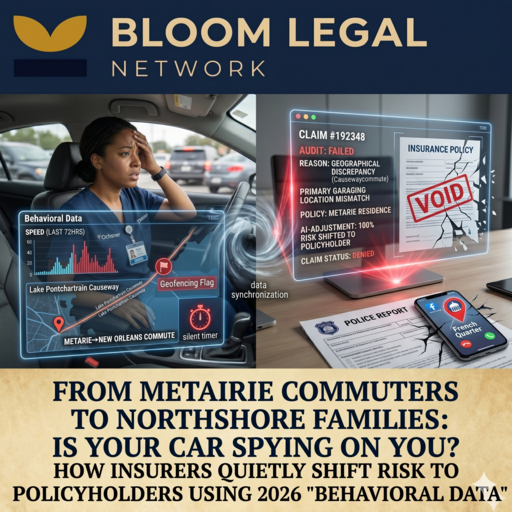
You’ve spent decades building a life in Southeast Louisiana, whether you’re commuting from Mandeville to New Orleans for work or managing a busy household in the heart of Jefferson Parish. You pay your premiums, follow the law, and trust that your insurance company will be there when the unthinkable happens. However, the legal landscape of 2026 has introduced a predatory shift in the industry. How insurers quietly shift risk back to policyholders has evolved from a matter of fine print into a high-stakes digital audit. At Bloom Legal Network, we are seeing established professionals—nurses at Ochsner, engineers in Kenner, and business owners in St. Tammany—suddenly facing claim denials because of “invisible” data discrepancies that insurers are now using to bypass their financial obligations.
The “Data-Sync” Era: How Your Neighborhood Data is Weaponized
In previous years, a car accident on Veterans Memorial Boulevard or a fender-bender in a St. Charles Parish parking lot was a straightforward matter of physical evidence. That era is officially over. Today, insurance carriers operating in Southeast Louisiana utilize integrated AI tools that cross-reference your claim against a massive web of local databases in real-time.
When you file a claim, the adjuster isn’t just checking your coverage limits; they are looking for “Risk Friction Points.” These are small, seemingly insignificant gaps between your daily habits and your policy disclosures. For instance, if you’ve moved from an apartment in the Garden District to a new home in Metairie but haven’t updated your “primary garaging location” on your policy, that minor administrative delay is now flagged as “material misrepresentation.”
At Bloom Legal Network, we’re a full-service law firm backed by a trusted network of experienced attorneys who understand that the insurance companies have changed the rules of the game. We ensure that your defense is proactive, not reactive.
The “72-Hour Digital Trap”: What Insurers Really Track
One of the most jarring aspects of how insurers quietly shift risk back to policyholders is the speed at which they harvest “behavioral evidence.” In 2026, your digital footprint—GPS data from your phone, automated toll tags on the Causeway, and even smart-city sensors in New Orleans—is used to verify your “risk profile” at the exact second of an accident.
- The Geofencing Audit: Officers and insurance investigators now look for “geographical consistency.” If your policy says you commute 10 miles but your digital pings show you’re consistently driving across the Twin Spans to Slidell for side-gigs, they will use that “undisclosed mileage” to shift the liability of an accident back to you.
- The “Silent Timer” on Disclosure: For licensed professionals in the medical or maritime sectors, even a minor traffic citation in St. Bernard Parish triggers a “silent timer.” If you don’t report an incident to your insurer within their proprietary “transparency window,” they may use that delay to argue a breach of contract, even if the accident wasn’t your fault.
Our clients trust us because we put their needs first. We don’t just wait for the insurance company to find a reason to say “no”; we conduct a proactive audit of your Southeast Louisiana records to ensure your “life-side” data matches your paperwork.
Why “Standard” Legal Advice is a 2026 Liability
Many policyholders mistakenly believe that a generalist attorney can handle the technical complexities of a 2026 insurance dispute. However, the unique intersection of Louisiana’s civil law and the specific data-sharing habits of Southeast Louisiana parishes requires a localized, high-tech strategy.
How insurers quietly shift risk back to policyholders often relies on the “local context” of the evidence. A generic demand letter carries zero weight in 2026 compared to a verified record of community integration and technical data compliance. If your case requires specialized knowledge—such as the intersection of maritime law near the Port of New Orleans and personal injury—we have a network of attorneys we trust to bring in for specialized insights. However, we stay by your side the entire way, managing the process and protecting your interests from the first phone call to the final settlement.
The Hidden Danger of “Low-Level” Local Admissions
It is easy to look at a “minor” traffic ticket in Jefferson Parish or a small citation in Orleans Parish and think, “I’ll just pay the fine online and move on.” In the current climate of 2026, this is a catastrophic strategic error.
A “guilty” plea to a minor charge—even one that doesn’t result in points on your license—can be classified as an “admission of negligence” by an insurance algorithm. Whether we handle your case directly or bring in a specialized partner, we look at the long-term insurance implications of every local legal move. We ensure that a $200 mistake in a Southeast Louisiana court doesn’t lead to a $200,000 denial of coverage later.
Managing the “Life Side” of the File
The 2026 legal landscape is ruthless toward those who are reactive. By securing a dedicated legal team early, you begin the work of compartmentalizing the legal battle. You focus on your career and your family in Southeast Louisiana while we handle the heavy lifting, navigating the intersection of data privacy, administrative policy, and insurance mandates.
At Bloom Legal Network, we remain your primary advocate, ensuring that no matter how many moving parts your case has, every “silent timer” is accounted for and every strategic advantage is seized.
📞 Call 504-599-9997
📧 Email info@bloomlegal.com
Frequently Asked Questions
How does the 2026 “Black Box” data from my car affect my Louisiana insurance claim? In 2026, almost every vehicle on the roads of Metairie and New Orleans is equipped with an Event Data Recorder (EDR). Insurers now use “Remote Retrieval” to pull your speed, braking force, and steering angle from the seconds before a crash. They use this data to find “Comparative Negligence.” Even if you were not the primary cause of the accident, if the data shows you were 5 mph over the limit or didn’t brake “optimally,” they will shift a percentage of the financial risk back to you. Bloom Legal Network works with technical partners to challenge these automated conclusions and ensure the data isn’t being taken out of context.
I live in St. Tammany but work in New Orleans. Can my insurer deny a claim based on my commute? Yes, and it is happening more frequently in 2026. Insurers are using “Commuter Audits” as a primary tool for how insurers quietly shift risk back to policyholders. If your policy was rated for a local Northshore commute but your daily digital footprint shows you are crossing the Causeway five days a week, they may claim “rate evasion.” This allows them to deny a claim or significantly reduce the payout following an accident. We help our clients audit their policies and data pings to ensure they are fully protected before a claim is even filed.
Can Bloom Legal Network assist if my insurance company is using “AI-adjusting” to lowball my settlement? Absolutely. This is exactly why our “Network” philosophy exists. The insurance industry in 2026 has moved toward “Algorithmic Adjusting,” where a computer determines your settlement based on regional averages in Southeast Louisiana rather than your specific medical needs and damages. If your case involves complex injuries or high-value property damage, we bring in specialized partners from our trusted network who understand how to break the “AI-loop” and force a human review of the facts. You get the benefit of hyper-specialized knowledge while Bloom Legal Network remains your primary point of contact, ensuring your interests are never sidelined by an algorithm.