Field Sobriety Tests in Louisiana: Are They Optional?
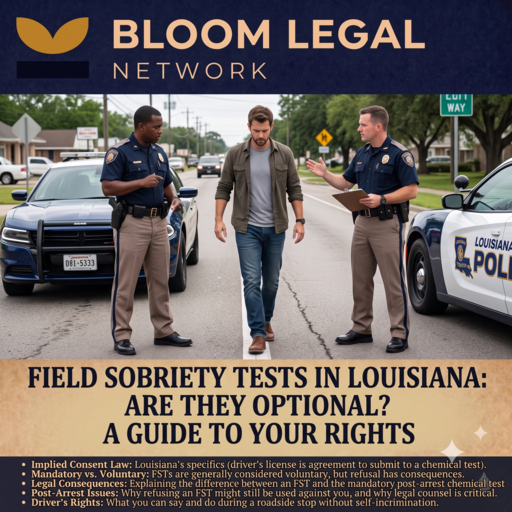
A Louisiana driver pulled over on suspicion of DWI can decline the roadside walk-and-turn, the one-leg stand, and the eye test — and doing so carries none of the automatic license penalties that come with refusing a breath or blood test after arrest.
That distinction surprises most drivers, because officers rarely explain it and the two requests get lumped together as if they’re the same thing. They aren’t. Understanding where the line falls is the single most useful piece of information a driver can have during a stop.
1. The Two Categories of “Testing” — and Why Louisiana Treats Them Differently
Louisiana recognizes two separate testing regimes, and only one is backed by a statute compelling participation.
Field sobriety tests (FSTs) are the roadside battery: Horizontal Gaze Nystagmus (following a pen or light with the eyes), Walk-and-Turn, and One-Leg Stand. These are performance exercises scored by the officer’s observation, and a person can register “clues” on any or all three for reasons unrelated to alcohol or drugs.
Chemical tests are breath, blood, or urine analysis conducted after arrest to measure blood alcohol concentration or detect controlled substances.
The key distinction: FSTs are voluntary. Chemical tests are governed by Louisiana’s implied consent statute and carry mandatory license consequences for refusal — and, in two specific situations covered below, criminal penalties.
2. Why FSTs Are Voluntary: The Statutory Gap
Implied consent in Louisiana is defined narrowly. R.S. 32:661(A)(1) provides that any person who operates a motor vehicle on Louisiana’s public highways is deemed to have consented to a chemical test of blood, breath, urine, or other bodily substance when arrested for an offense involving suspected impairment.
The statute’s language is test-specific. It names chemical analysis of bodily substances. It does not extend to physical coordination exercises performed roadside before an arrest occurs.
Because no statute imposes a duty to perform FSTs, there is no license-suspension trigger for declining them. An officer cannot compel a driver to take one, and a driver who doesn’t want to participate should decline politely.
Two things declining does not do. First, it doesn’t prevent an arrest. An officer can still develop probable cause from other observations — driving pattern, odor of alcohol, slurred speech, admissions made during the stop. Second, it isn’t invisible. The officer will document the refusal, and how a Louisiana court treats that at trial is a fact-specific question worth raising with counsel rather than assuming cuts one way.
3. Why Chemical Tests Are Different: The Refusal Penalty Structure
Once arrest occurs, the calculus changes. Under R.S. 32:666 and 32:667, refusing a chemical test triggers an administrative suspension of driving privileges, and the penalty escalates with prior refusals.
| Scenario | What happens | What to do about it |
|---|---|---|
| First refusal | One-year suspension of driving privileges | Request the administrative hearing in writing within 30 days of arrest; ask counsel about restricted-license eligibility with an ignition interlock |
| Second or subsequent refusal within ten years of a prior refusal | Two-year suspension | Counsel should review the prior refusal record for procedural defects before conceding the enhancement — a prior suspension that was reversed or recalled doesn’t count |
| Third refusal(two previous separate refusals) | Refusal itself becomes a crime under R.S. 14:98.7 — a fine of $300 to $1,000 and 10 days to 6 months in jail, on top of the suspension | This is a criminal charge in its own right; get counsel involved immediately |
| Fatality or serious bodily injury crash | The driver may not lawfully refuse at all under R.S. 32:666(A)(1). Refusing carries the same $300–$1,000 fine and 10-day-to-6-month jail exposure. Suspension is one year — but without eligibility for a hardship license | These cases move quickly toward felony-level exposure; immediate counsel involvement |
| Any refusal, generally | Refusal is admissible against the driver in the criminal case, and in the civil proceeding to suspend or revoke driving privileges | Address the constitutional and procedural challenges to the stop itself, not just the refusal |
A note on the fatality/serious-injury row, because it’s commonly misstated: the suspension there is one year, the same length as a standard first refusal. What changes is that the driver loses hardship-license eligibility — and that consequence attaches when a trier of fact determines the driver’s intoxication was the contributing factor. “Serious bodily injury” is defined in the statute as injury involving unconsciousness, protracted and obvious disfigurement, protracted loss or impairment of a bodily member, organ, or mental faculty, or a substantial risk of death.
The key risk: unlike an FST refusal, a chemical test refusal is a documented event with its own separate legal consequence. The administrative suspension proceeds independently of whether the DWI charge itself succeeds.
4. What a Suspension Actually Looks Like
“One year” overstates the practical effect for most first-time refusals, and it’s worth knowing why before deciding anything.
Under R.S. 32:667(B)(3)(a), a licensee suspended for a first or second offense who refused the test is immediately eligible for a restricted license once they show the Department of Public Safety and Corrections that their vehicle has a functioning ignition interlock device. If the department declines to issue it, the district court where the licensee lives can order it.
The flip side: under R.S. 32:667(I), an ignition interlock is mandatory as a condition of reinstatement after any refusal — first, second, or subsequent — and must stay on the vehicle for at least six months.
So the realistic picture after a first refusal is usually not twelve months without driving. It’s twelve months of driving on a restricted license with an interlock installed, at the driver’s expense.
5. Refusing Doesn’t Always Mean No Sample Is Taken
This is the part most articles on this topic leave out. Refusing the test is not the same as preventing the test.
Louisiana law enforcement agencies run “No Refusal” programs — routinely around holidays, and year-round in a number of parishes — under which a magistrate is on call to sign a search warrant for a blood draw when a driver arrested for DWI refuses. A driver who refuses may still end up providing a sample, this time under warrant, with the refusal also on the record.
There is a live constitutional question layered on top of this. In Birchfield v. North Dakota, 579 U.S. 438 (2016), the U.S. Supreme Court held that a warrantless breath test may be conducted as a search incident to a lawful DWI arrest, but a warrantless blood draw may not — and that a state cannot impose criminal penalties on a driver for refusing a warrantless blood test. Because Louisiana’s refusal statutes carry criminal penalties in the two situations described above, whether those penalties can constitutionally attach depends in part on which test was demanded and whether a warrant was obtained. That is a question for counsel on the specific facts, not a general rule a driver can rely on at roadside.
6. What Happens if a Driver Takes the FST Anyway
Most drivers who agree to FSTs do so believing cooperation will look better to an officer, a prosecutor, or a jury. In practice, FST results are frequently contested:
- Administration protocol. The National Highway Traffic Safety Administration’s standardized battery requires a specific sequence, surface conditions, and instructions. Deviation is one of the most common grounds for excluding or discounting results.
- Medical and situational confounders. Inner ear conditions, certain medications, uneven pavement, footwear, fatigue, and plain nervousness in front of a uniformed officer can all produce “clues” recorded as impairment indicators.
- Officer training and documentation. Body camera footage often contradicts an officer’s written account of how a driver performed — a gap defense counsel can use at both the suppression stage and trial.
7. What Happens After a Chemical Test Refusal
Expect three things in sequence:
- The officer reads the statutory advisory. Before requesting the test, the officer must read a standardized DPSC form that informs the driver of his constitutional rights under Miranda v. Arizona, that driving privileges can be suspended for refusing, that they can be suspended for a test result at or above the legal threshold, and — a detail worth noting — the name and employing agency of every officer involved in the stop, detention, investigation, or arrest. The officer then asks the driver to sign the form.
- The license is seized and a temporary receipt issued, valid for up to 30 days from the date of arrest.
- A 30-day window opens to request the administrative hearing in writing. This is a civil proceeding, separate from the criminal DWI case, and it runs on its own clock.
On that deadline: it is 30 days from the date of arrest, not from conviction. Missing it means the suspension takes effect without a hearing. There is one narrow relief valve — if the driver couldn’t make a timely request because of incarceration, hospitalization, or another cause the department finds acceptable, documentation can support a late request filed no later than 90 days from arrest. That is an exception to document and invoke, not a second deadline to rely on.
8. The Practical Playbook for a Louisiana Traffic Stop
- Provide license, registration, and proof of insurance. This is a legal obligation independent of any sobriety testing.
- Decline field sobriety tests politely and without a speech explaining why. There is no license penalty for declining.
- Understand that declining FSTs does not prevent an arrest if the officer already has other grounds for probable cause.
- If arrested, listen carefully to the implied consent advisory — it determines the consequences of the next decision.
- Know that refusing the post-arrest chemical test carries an automatic license suspension separate from the criminal case, that a warrant may produce a blood sample anyway, and that a third refusal or a refusal in a fatality or serious-injury crash is itself a crime.
- Contact counsel immediately after any arrest, before the 30-day administrative deadline passes.
Frequently Asked Questions
Can an officer arrest me solely because I declined a field sobriety test? Refusal alone is rarely sufficient. An officer may treat it as one factor supporting probable cause, but it is typically combined with other observations from the stop.
Does refusing an FST look bad in front of a jury? It can be framed either way at trial. Louisiana counsel routinely argues that declining a subjective roadside exercise is the exercise of a legal right, not evidence of guilt. How much room there is to make that argument depends on the facts and the court.
Is there any situation where I must submit to a chemical test? Yes. Under R.S. 32:666(A)(1), a driver may not refuse where a fatality occurred or a person sustained serious bodily injury in the crash, or where the driver has refused on two previous and separate occasions. Refusing in those situations is a crime.
How long do I have to challenge a license suspension after refusing? Thirty days from the date of arrest — not from the date of conviction. A late request may be accepted up to 90 days from arrest if the driver was incarcerated, hospitalized, or otherwise unable to file on time and can document it.
Will I lose my license for a full year with no way to drive? Not necessarily. A driver suspended for a first or second refusal is immediately eligible for a restricted license on proof that an ignition interlock device has been installed. The interlock is required for at least six months as a condition of reinstatement.
Do the same rules apply to a nonresident driver stopped in Louisiana? Yes. Under R.S. 32:669, when a nonresident refuses testing the arresting agency notifies the department, which reports in writing to the motor vehicle administrator of the driver’s home state and any state where the driver holds a license. Louisiana is a member of the Driver License Compact.
 A Note From Bloom Legal
Every DWI stop carries its own facts, and small details — the exact wording an officer used, the condition of the road surface, the timing of the advisory — can change the outcome. Nothing in this article is legal advice for a particular situation. If you or someone you know is facing a DWI arrest or a license suspension hearing in Louisiana, reach out to Bloom Legal Network before any deadlines pass.
Citation Reference Table
| Citation | Subject | Amendment status |
|---|---|---|
| La. R.S. 32:661 | Implied consent to chemical tests; contents of the advisory form | Amended by 2020 Reg. Sess. Act 40 (C(1)(d)–(e) amended, D enacted, C(1)(f) repealed) |
| La. R.S. 32:666 | Refusal to submit to chemical test; exception; effects | Amended through Acts 2022, No. 393 (repealing subsection D) and Acts 2024, No. 662 |
| La. R.S. 32:667 | Seizure of license; temporary license; suspension periods; ignition interlock | Amended through Acts 2023, No. 409 and No. 462, and Acts 2024, 2nd Ex. Sess., No. 9 (eff. July 1, 2024) |
| La. R.S. 32:668 | Procedure following revocation; administrative hearing; restricted licenses | Verify current text before citing |
| La. R.S. 32:669 | Notification to the home state of a nonresident who refuses testing | — |
| La. R.S. 14:98 | Operating a vehicle while intoxicated | Amended frequently; confirm current version independently |
| La. R.S. 14:98.7 | Unlawful refusal to submit to chemical tests | Formerly R.S. 14:98.2; renumbered by Acts 2014, No. 385, eff. Jan. 1, 2015; amended by 2020 Act 40 |
| Birchfield v. North Dakota, 579 U.S. 438 (2016) | Warrantless breath test permissible incident to arrest; warrantless blood draw is not; criminal penalties cannot attach to refusing a warrantless blood test | — |