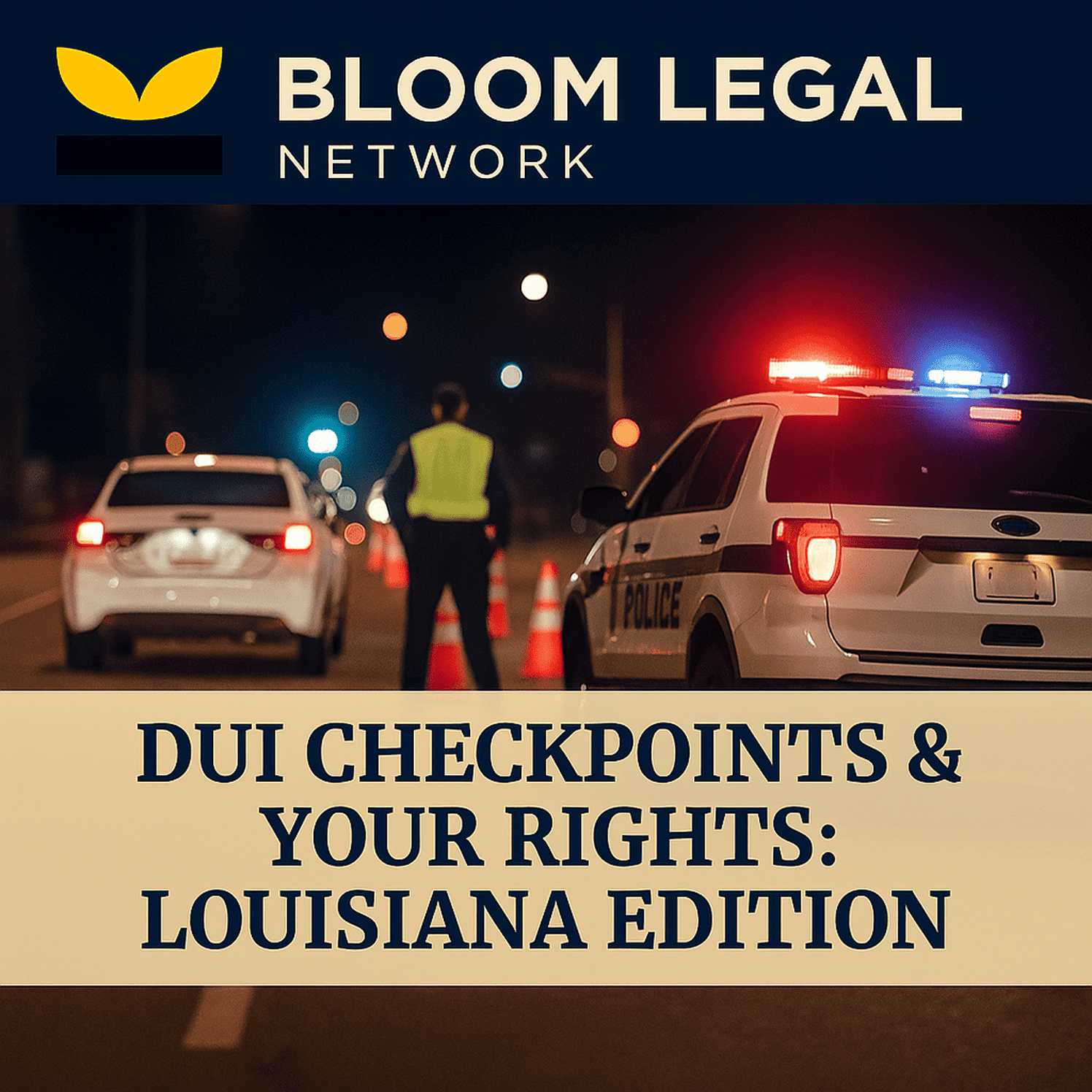
DUI Checkpoints & Your Rights: Louisiana Edition
Stopped at a DUI Checkpoint in Louisiana? Here’s What Police Can (and Can’t) Do
Driving home late in Louisiana, whether from work, dinner with friends, or a night out in New Orleans, can suddenly turn stressful when you see flashing lights ahead. DUI checkpoints in Louisiana are legal, but many drivers don’t fully understand their rights when approaching one. Knowing what officers are allowed to ask—and what you’re allowed to say—can make a significant difference in how a stop unfolds and, critically, prevent a misdemeanor arrest from becoming a costly conviction.
Understanding DUI checkpoints in Louisiana is especially important because these stops are designed to be brief, yet they often lead to arrests based on misunderstandings, confusion, or pressure-filled decisions made in the moment. At Bloom Legal Network, we regularly help clients across Jefferson Parish, Metairie, St. Charles Parish, and Southeast Louisiana navigate the aftermath of checkpoint stops that escalated quickly, often due to minor errors made by the driver or violations of procedure by the police.
Are DUI Checkpoints Legal in Louisiana? (The Constitutional Requirements)
Yes. DUI checkpoints are legal in Louisiana, but only when law enforcement follows specific constitutional and procedural rules established by state and federal courts. These checkpoints are meant to deter impaired driving, not to serve as open-ended investigations targeting specific individuals.
To comply with the law (and ensure any evidence gathered is admissible in court), DUI checkpoints in Louisiana must meet strict requirements, including:
- Advance Planning and Approval: The checkpoint must be planned in advance and formally approved by supervisory personnel.
- Neutral Stopping Criteria: Law enforcement must use a neutral, non-discretionary formula for stopping vehicles (such as every third or fifth car). They cannot arbitrarily choose which drivers to pull aside.
- Clear Visibility and Marking: The location must be clearly marked with signs, cones, and visible police presence to notify drivers ahead of time.
- Limited Officer Discretion: Officers must limit their individual discretion during the initial stop; the stop’s purpose is limited to a brief inquiry into sobriety.
Legal Tip: If these requirements aren’t met, any evidence gathered during the stop may be challenged later. This is where having a legal team familiar with Louisiana DUI checkpoint law becomes critical, as the defense may hinge on procedural violations, not driver conduct.
🛑 What Police Can and Must Ask at a Louisiana DUI Checkpoint
At a lawful DUI checkpoint in Louisiana, officers are typically allowed to:
- Request Documents: Ask for your driver’s license, vehicle registration, and proof of insurance. You must provide these items.
- Ask Brief Questions: Ask quick, simple questions related to sobriety (e.g., “Have you been drinking tonight?”).
- Observe Behavior: Observe and document visible signs of impairment such as slurred speech, the smell of alcohol, or fumbling for documents.
The stop should remain brief—no more than a few minutes—unless officers claim they have reasonable suspicion to continue investigating. In many DUI cases we see in New Orleans and St. Tammany Parish, the key legal question becomes whether that suspicion was actually justified and not based on a pretext.
If you’re unsure whether a stop crossed the line, Bloom Legal Network can review the checkpoint setup, and the entire arrest process to determine whether your Fourth Amendment rights were respected.
🚫 5 Things You Are NOT Required to Do at a Louisiana DUI Checkpoint
Many drivers don’t realize they still have rights during a checkpoint stop. Knowing what you are—and are not—required to do can help protect you from unnecessary criminal charges.
During a checkpoint stop in Louisiana:
You must provide:
- A valid driver’s license
- Vehicle registration
- Proof of insurance
Beyond that, you are not required to:
- Answer investigative questions.
You do not have to explain where you’re coming from, where you’re going, or why you are out late. You may politely decline to answer questions beyond providing required documents. - Admit to drinking alcohol.
You are not legally required to admit whether you have been drinking. Choosing not to answer is protected by the Fifth Amendment. - Perform field sobriety tests (FSTs).
Standard roadside tests—such as the walk-and-turn, one-leg stand, or eye test (HGN)—are voluntary in Louisiana. Politely declining these tests may limit the physical evidence used against you later. - Consent to a vehicle search.
Police generally need probable cause or your permission to search your vehicle. Being stopped at a checkpoint alone does not give officers the right to search your car. - Volunteer additional information.
You have the right to remain silent. Staying calm, respectful, and limiting your responses to what is legally required is often the safest approach.
Important note:
If you are placed under arrest, Louisiana’s implied consent law applies to chemical breath or blood tests. Refusing a post-arrest chemical test can result in license suspension and other penalties.
What Happens If You Are Arrested at a DUI Checkpoint?
An arrest at a DUI checkpoint can trigger multiple serious consequences that begin immediately:
- Criminal Charges: Misdemeanor charges requiring a court appearance in parish or municipal court.
- Administrative License Suspension: The immediate risk of losing your driving privileges through an administrative action with the Louisiana OMV.
- Long-Term Impact: Potential complications with auto insurance rates, future employment, and reputation.
Even first-time DUI arrests can have lasting effects. At Bloom Legal Network, we take a full-picture approach—looking beyond just the criminal charge itself to protect your driving privileges, reputation, and future opportunities.
Because we are a full-service law firm backed by a trusted network of experienced attorneys, we’re able to manage every stage of the process, from the initial OMV hearing to the final court resolution. We are dedicated to providing a vigorous defense for every client facing a DUI checkpoint case.
🔎 Why DUI Checkpoint Cases Deserve Close Legal Review
DUI checkpoint cases often hinge on procedural details most people never think to question. The difference between a conviction and a dismissal often lies in law enforcement’s strict adherence to constitutional protocol.
We scrutinize every detail of your stop:
- Was the checkpoint publicly announced or approved?
- Were vehicles stopped according to the neutral plan, or did the officer select drivers based on personal bias?
- Did officers exceed the scope of the brief stop without developing reasonable suspicion?
- Was the request for Field Sobriety Tests or a chemical test administered correctly?
These details matter immensely. Many DUI cases in Metairie and New Orleans are resolved not because of what the driver did—but because of what law enforcement failed to do correctly under the law.
If you’re unsure whether your DUI checkpoint stop was handled properly, Bloom Legal Network can help you understand your options and next steps.
Ready to Discuss Your Louisiana DUI Checkpoint Stop?
📞 Call 504-599-9997
📧 Email info@bloomlegal.com
FAQs about DUI Checkpoints & Your Rights
Can police search my car at a DUI checkpoint in Louisiana?
Police cannot search your vehicle at a checkpoint without your consent or probable cause. Simply being stopped at a checkpoint does not automatically give officers the right to search your car. If a search occurred without proper legal justification, the evidence may be challenged and suppressed. A legal team can review whether the search complied with Louisiana and federal law.
Do I have to answer questions about drinking at a DUI checkpoint?
You must provide basic identifying documents (license, registration, insurance), but you are not required to answer questions about drinking, your plans, or your activities. Politely declining to answer is within your rights. Statements made at checkpoints are frequently used later in court, which is why limiting your responses is often advisable to protect your rights in a DUI checkpoint case.
What should I do if I believe my rights were violated at a checkpoint?
If you believe your rights were violated, document everything you remember as soon as possible—location, time, signage, and officer conduct. Avoid discussing details publicly or on social media. The most critical step is contacting Bloom Legal Network to have your situation reviewed carefully so informed decisions can be made about how to proceed with your DUI defense.