Why Your “Two Drink” Limit Might Fail You at a New Orleans DUI Checkpoint: A Guide to Your Rights
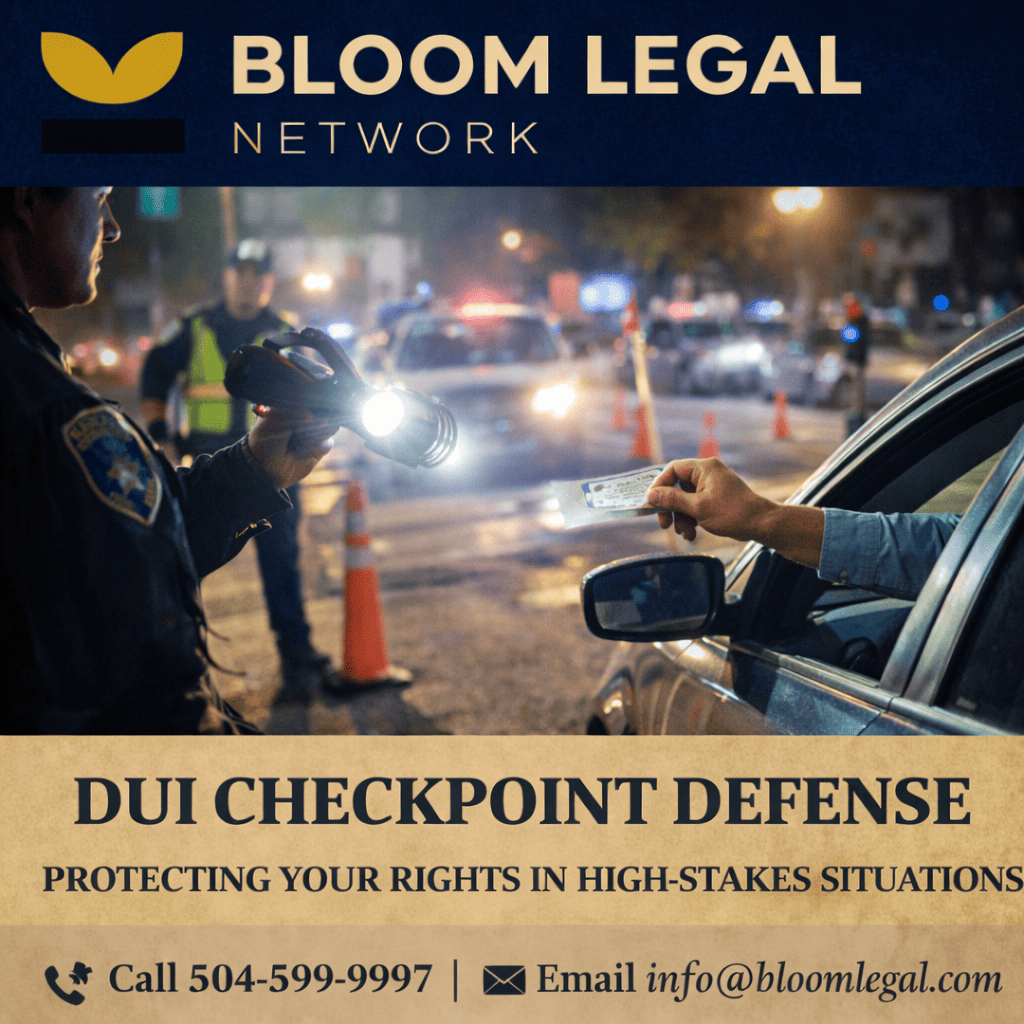
It’s 11:30 PM on a humid Saturday. You’ve just finished a great dinner in the Warehouse District of New Orleans or caught the end of the game at a bar in Metairie. You feel fine; you stayed within your “two-drink limit” and you’re driving your usual route home. Then, you see them: the blinding floodlights and the sea of blue and red strobes cutting through the dark. You’ve just entered a DUI Checkpoints & Your Rights: Louisiana Edition scenario. In this high-pressure moment, the gap between going home and being hauled to central booking isn’t your blood alcohol level—it’s how much you know about your constitutional protections.
Understanding DUI checkpoints is crucial for every driver in Louisiana. Louisiana DUI checkpoints are legal when conducted according to specific guidelines, and knowing your rights at these stops can help you avoid misunderstandings or wrongful arrests.
Most drivers believe that being overly helpful and “chatty” will prove their sobriety. In the world of criminal law in Louisiana, however, silence isn’t just a right; it’s your best defense. A sobriety checkpoint is a structured gathering of evidence, and the primary goal of these checkpoints is to identify impaired driving and protect public safety. If you find yourself rolling down your window for a flashlight-wielding officer, do not let your desire to be a “good citizen” turn into a self-incriminating statement. Bloom Legal Network is here to ensure that a single night out doesn’t turn into a life-altering legal battle.
The Constitutional Loophole: How DUI Checkpoints Are Legal
In many parts of the country, sobriety checkpoints are viewed as a violation of the Fourth Amendment’s protection against unreasonable searches and seizures. However, the Louisiana Supreme Court has paved a different path. DUI checkpoints are legal in Louisiana when law enforcement conducts them according to Fourth Amendment rights and follows proper procedures. These stops are considered legal under criminal law in Louisiana, provided law enforcement follows a very specific “boilerplate” of administrative guidelines.
Whether you are navigating the streets of Jefferson Parish or passing through St. Charles Parish, the police cannot simply pull over cars based on a “hunch.” There must be a pre-approved, systematic plan—such as stopping vehicles based on neutral criteria, like every car or every fourth car, rather than solely on suspicious behavior. Additionally, these checkpoints are temporary roadblocks that must be publicly announced in advance to comply with legal requirements. Yet, even within these strict rules, officers are trained to look for any “material fact” to escalate your stop. A slightly fumbled license or the scent of a passenger’s drink can be enough to transform a 30-second check into a multi-hour investigation.
If you suspect your stop was a result of profiling or that the officers deviated from their mandated protocol, you need a legal team that understands the procedural nuances of Southeast Louisiana courts. At Bloom Legal Network, we’re a full-service law firm backed by a trusted network of experienced attorneys who know how to audit police logs and checkpoint authorizations to find the errors that could get your case dismissed.
The “Politeness” Trap: Why Your Words Are Evidence and Your Right to Remain Silent
The most common mistake we see from professionals in New Orleans and St. Tammany Parish is the “Over-Explainer.” An officer leans in and asks a seemingly casual question: “Where are you coming from tonight?”
You think you’re being helpful by saying, “Just a friend’s house in Metairie, we had a couple of glasses of wine with dinner, but I’m perfectly fine to drive.”
In that five-second sentence, you have handed the prosecution:
- Direct Admission: You admitted to consuming alcohol.
- Probable Cause: You gave them the “reasonable suspicion” needed to order you out of the vehicle for further testing.
At DUI checkpoints, police officers will ask you to provide your driver’s license, registration, and proof of insurance. You are not required to discuss your evening or your destination. Politely stating, “I choose to remain silent and would like to speak with my attorney,” is often the smartest move you can make.
If you believe your rights were violated during the stop, document officer conduct as soon as possible.
Our clients trust us because we put their needs first. If your case requires specialized knowledge regarding the aggressive prosecution tactics in Jefferson Parish, we have a network of attorneys we trust—but we stay by your side the entire way, managing the process and protecting your interests.
Field Sobriety Tests: The Subjective “Science”
There is a massive misconception in Southeast Louisiana that you are legally obligated to perform physical Field Sobriety Tests (FSTs). You’ve seen them: the “walk-and-turn,” the “one-leg stand,” or the “HGN” test (following a pen with your eyes). If an officer suspects you are impaired—meaning they have reasonable suspicion based on your behavior or other observations—they may ask you to perform field sobriety tests to assess your condition.
Here is the “Wow” factor: These tests are not “pass/fail” in the way you think. They are “clue-based” evaluations where the officer is looking for reasons to arrest you, not reasons to let you go. Even a sober person can “fail” due to:
- Environmental Factors: Uneven asphalt on a New Orleans side street or the glare of passing headlights.
- Physical Conditions: Back issues, inner ear problems, or even simple nerves.
- Age and Weight: Factors that have nothing to do with alcohol but everything to do with balance.
In Louisiana, you have the right to refuse these physical tests. While a refusal might lead to a “forced” arrest if the officer claims they smell alcohol, it denies the District Attorney the video evidence of you “stumbling” that they would otherwise use to sway a jury.
To Blow or Not to Blow? The Implied Consent Dilemma
When the officer pulls out the portable breathalyzer at a St. Tammany Parish checkpoint, you are facing the most critical decision of the night. The officer may ask you to take a breathalyzer test, which is a type of chemical test used to assess your blood alcohol content. Under Louisiana’s “Implied Consent” law, by driving on state roads, you have already agreed to chemical testing.
- The Penalty for Refusal: Refusing a chemical test, such as a breathalyzer, usually results in an immediate driver’s license suspension (often 1 year for a first offense) and may subject you to other penalties under Louisiana law.
- The Risk of Submission: A BAC reading at or above the legal BAC limit of .08% is “per se” evidence of intoxication, making the case much harder to fight in a St. Charles Parish or Jefferson Parish court. Failing or refusing the test can also result in a DUI charge.
The decision is a catch-22. However, whether we handle your case directly or bring in a specialized partner, you’ll always have a dedicated legal team working for you—from start to finish—to challenge the results of that breathalyzer or fight for your driving privileges at an administrative hearing.
Why Early Intervention is Everything
A DUI conviction in Southeast Louisiana is more than just a “bad night.” It is a permanent criminal record that can lead to:
- Professional License Suspension: Affecting nurses, pilots, and lawyers.
- Employment Consequences: Especially for those in the construction or maritime industries who require specialized clearances.
- Financial Strain: High fines, increased insurance premiums, and the cost of an ignition interlock device.
Challenging evidence collected during the initial stop or traffic stop is crucial, as procedural errors or improper collection methods can significantly impact your case. In Orleans Parish, understanding local legal procedures and your rights from the initial stop onward is essential.
At Bloom Legal Network, we don’t just look at the arrest report; we look at the big picture. Was the breathalyzer machine (Intoxilyzer 9000) calibrated within the last 30 days as required by Louisiana law? Did the officer maintain the mandatory 15-minute observation period before the test? Was any evidence gathered during a search incident to arrest? These “boilerplate” details are where cases are won.
Our defense strategies focus on challenging evidence, identifying procedural violations, and leveraging effective DUI defense tactics to contest charges. If you are facing license suspension, you may be eligible for a hardship license in Orleans Parish, allowing limited driving privileges for work, school, or medical needs.
If you are worried that a mistake at a checkpoint is spiraling into a criminal indictment, do not wait for a court summons. Your defense begins the moment the handcuffs click.
📞 Call 504-599-9997
📧 Email info@bloomlegal.com